
What Makes Underground Pool Plumbing Leaks So Dangerous
Of all the places a pool can leak, a buried plumbing line is the most destructive and the hardest to find without professional equipment. When a PVC return line, skimmer suction pipe, or main drain line develops a crack or joint separation beneath your concrete deck, the escaping water has nowhere to go except into the surrounding soil. Over days and weeks, that saturated soil compacts, shifts, and erodes — and the surface above it may show no visible sign of a problem until the damage is already severe.
In West Hollywood, the combination of aging pool infrastructure (many pools in the area were built in the 1960s and 1970s), expansive clay soils, and the low-level seismic activity common throughout the Los Angeles basin creates ideal conditions for underground plumbing failures. Glued PVC joints that were installed forty years ago may have been perfectly sound for decades before a small ground movement separates the fitting enough to allow water to escape continuously.
Warning Signs of an Underground Pool Plumbing Leak
Because the leak is underground, you won't see a puddle or a dripping fitting. Instead, homeowners typically notice one or more of the following symptoms:
- Consistent water level drop that exceeds evaporation: If your pool loses more than a quarter-inch of water per day even when the weather is mild, and the bucket test confirms it is not evaporation, a buried line is a strong suspect.
- Soft or sunken spots near the pool deck: Soil erosion caused by underground water loss can create depressions or soft zones in the ground adjacent to the pool, or even small sinkholes along the path of the plumbing.
- Cracks appearing in the deck or coping: As soil washes away beneath a concrete deck, the unsupported slab can crack or settle unevenly. New cracks appearing in previously solid decking are a red flag.
- Higher-than-expected water bills: Even small continuous losses from a buried line add up to thousands of gallons per month, and the resulting spike in your LADWP bill can be the first indicator something is wrong.
- Pool losing water only when the pump runs: If water loss accelerates when the circulation system is active but stabilizes when the pump is off, a pressurized return line is likely the source rather than the shell or a gravity-fed drain.
- Wet areas in the yard away from the pool: Depending on where the plumbing routes through your yard, saturated ground or unusually green, lush grass patches along the pipe path can indicate a slow underground release.
What Causes Underground Pool Plumbing to Fail in West Hollywood
There is no single cause of buried line failures. Our technicians encounter several recurring culprits at West Hollywood properties:
- Joint separation at glued PVC fittings: Older pools used solvent-weld PVC fittings that can degrade over decades, especially when subjected to soil movement. Even minor seismic activity can separate a joint that had been holding by a thin film of old adhesive.
- Root intrusion: Tree roots growing toward the moisture around a pool plumbing system will follow the path of least resistance, sometimes penetrating compromised joints and widening cracks over time.
- Soil settlement: Expansive clay soils in the Los Angeles basin expand when wet and contract when dry, creating cyclical stress on rigid plumbing lines that eventually causes fatigue cracks or fitting separation.
- Corrosion at metal fittings: In pools with older brass or copper fittings where PVC transitions to metal, galvanic corrosion can eat through fittings at the transition point, creating a leak that worsens gradually over years.
- Improper original installation: Some pool plumbing lines installed in the 1970s and 1980s were not bedded in compacted sand, leaving them exposed to uneven soil pressure that eventually causes cracking at stress points.
How We Locate Underground Leaks Without Excavating Your Entire Deck
Wide-area excavation to find a buried pool plumbing leak is expensive, disruptive, and entirely unnecessary with modern detection methods. Our underground pool plumbing leak detection service uses a two-phase approach that narrows the leak location to a very small area before any concrete cutting or digging begins.
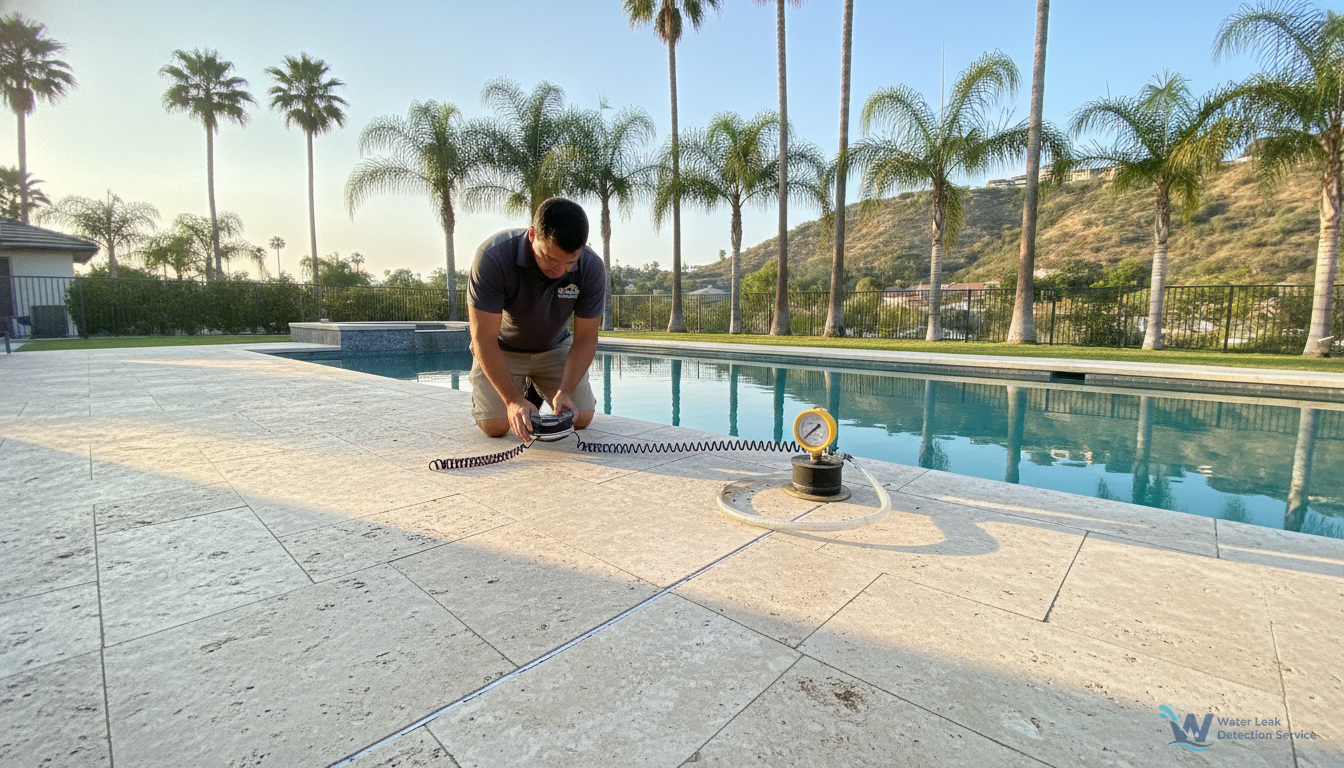
Phase 1 — Pressure testing: Our technicians insert rubber expansion plugs into each plumbing circuit opening at the pool wall and connect a calibrated pressure pump. Each line — skimmer suction, main drain, return lines, cleaner ports — is isolated and pressurized individually. Our pressure testing service identifies exactly which circuit is failing and confirms the presence of a leak with a quantified pressure drop reading. This rules out any lines that are holding pressure and focuses attention on the one or two circuits that are not.
Phase 2 — Electronic acoustic location: Once a failing line is confirmed, our technicians use handheld electronic ground-microphone sensors pressed against the deck surface above the suspected pipe route. These sensors detect the ultrasonic frequency signature of pressurized water or tracer gas escaping through a crack or joint gap, allowing the technician to walk the pipe route and identify the point of maximum signal intensity. In most cases this narrows the leak location to within twelve inches — dramatically reducing the footprint of any subsequent excavation or concrete cutting.
What Happens After the Leak Is Located
At the end of every diagnostic visit, we provide a written report with pressure test results, acoustic findings, and photographs documenting the suspected leak location, approximate depth, and pipe type. This documentation gives you — and whichever repair contractor you choose — a precise target rather than a guessing game.
For a complete picture of your pool system's integrity, many West Hollywood homeowners combine underground plumbing detection with a full pool leak detection inspection that covers the shell, skimmers, returns, and equipment pad simultaneously. We also serve properties in Beverly Hills, Hollywood Hills, North Hollywood, and Culver City.
Schedule Your Underground Plumbing Inspection Today
Water Leak Detection Service operates Monday through Sunday, 8 AM to 6 PM, and can typically schedule inspections within the same week. If you are seeing any of the warning signs described above at your West Hollywood property, do not wait for a sinkhole to appear before acting. Call us at +1 (213) 444-5632 or email [email protected] to book your diagnostic appointment.
You can also learn more about our specific service areas: pool leak detection in West Hollywood and underground plumbing leak detection in West Hollywood.
Need Service?
Call +12134445632 or fill out our online form for a free, no-obligation quote.
Request Free Quote