Three Zones, Three Different Types of Pool Leaks
When a West Hollywood homeowner calls us because their pool is losing water, we approach the problem systematically. A pool is not a single structure — it is a system made up of the shell itself, the plumbing fittings embedded in that shell, the buried lines connecting everything, and the above-ground equipment pad where the pump, filter, and heater live. Leaks can develop in any or all of these zones simultaneously, and a complete diagnosis has to evaluate each one independently.
This guide focuses on the three most frequently encountered above-ground and at-shell leak sources: skimmer and return fitting failures, cracks in the pool shell, and leaks at the equipment pad. Each behaves differently, each has different causes, and each requires a different detection and repair approach.
Skimmer and Return Fitting Leaks: The Most Common Culprit
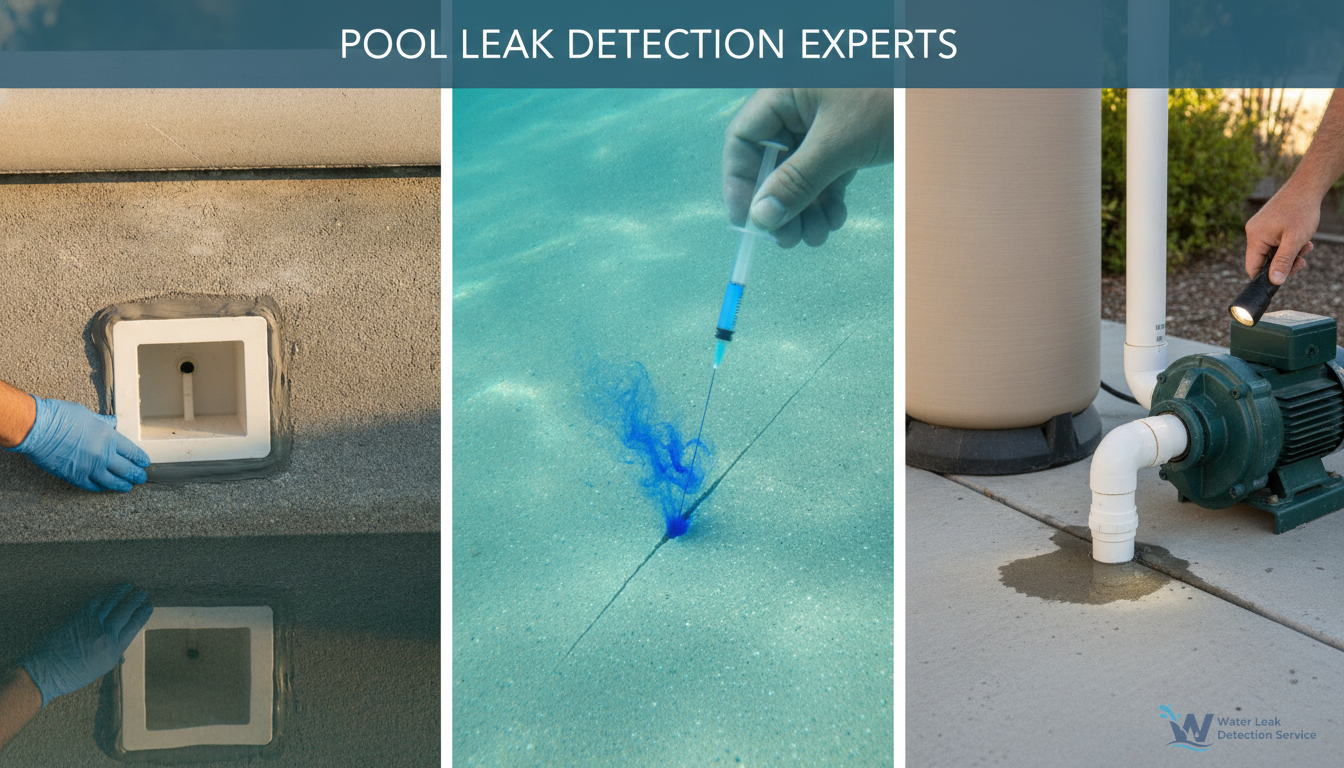
The skimmer — that rectangular opening in your pool wall that draws floating debris into the filtration system — is the single most common source of pool water loss we encounter at West Hollywood properties. Here is why: the skimmer body is a plastic component that is cast into the surrounding gunite or concrete shell during construction. Over time, as the surrounding soil shifts (and West Hollywood soils do shift, particularly the expansive clay layers found throughout the Los Angeles basin), the pool shell moves slightly while the rigid plastic skimmer body does not move at the same rate. The result is a gap — sometimes hairline-thin, sometimes clearly visible — between the skimmer body and the surrounding shell. Water that should be drawn into the skimmer throat instead flows through that gap and drains directly into the soil behind the pool wall.
Return jet fittings, eyeball nozzles, and hydrostatic relief valves built into the pool floor are similarly vulnerable. These fittings use rubber gaskets and plastic collars to seal against the pool shell, and those seals degrade with age, exposure to pool chemicals, and temperature cycling.
How we detect skimmer and return leaks: Dye testing is the primary method. A small amount of non-staining dye is introduced near the skimmer throat or fitting with the pump off. If the dye is drawn toward the fitting and disappears through a gap, the leak location is confirmed. Pressure testing of the associated plumbing line then determines whether the leak is limited to the fitting itself or extends into the buried plumbing beyond it. Our skimmer and return fitting leak repair service covers both diagnosis and the full repair process.
How we repair skimmer and return leaks: Minor gaps between a skimmer body and the surrounding shell are sealed using hydraulic-grade two-part epoxy and pool-rated flexible sealant that is formulated to bond to both plastic and gunite. For severely compromised skimmer bodies — those with structural cracking or complete separation — full skimmer replacement with proper bonding procedures is the more durable long-term solution. All sealants and materials we use are compatible with both chlorinated and saltwater pool environments and are designed to flex with seasonal temperature changes common in Southern California.
Pool Shell Cracks: Not All Cracks Are Equal
Walk around almost any gunite pool in West Hollywood that is more than fifteen years old and you will likely find cracks in the plaster surface. The important question is not whether cracks exist — it is whether those cracks penetrate through the shell and are actively allowing water to escape.
Surface crazing — a network of fine lines in the plaster coating — is a cosmetic issue caused by plaster age, chemical imbalance, or surface shrinkage. These lines do not penetrate the gunite layer beneath and do not cause water loss. Structural cracks, by contrast, run through the gunite shell itself and may allow water to migrate from the pool into the surrounding soil. In the Hollywood Hills and elevated West Hollywood neighborhoods, differential soil settlement from sloped terrain adds additional stress that can widen structural cracks over time.
How we detect active shell cracks: Our pool shell crack detection and sealing service begins with an underwater visual survey and dye testing of every crack that appears deeper than the plaster surface. Dye injected near a structural crack will be visibly drawn through the crack as the slight pressure differential pulls it into the gap. We photograph every tested crack and record whether it is active or cosmetic, giving you a precise map of what actually needs repair versus what can be left alone.
How we repair active shell cracks: The repair method depends on the shell material and the crack type. Active leaking cracks in gunite are typically sealed using underwater-injectable hydraulic epoxy or polyurethane injection systems — both of which bond to wet concrete and cure in submerged conditions, meaning in many cases the pool does not need to be drained. Hairline cracks in plaster surfaces may be addressed with pool-safe hydraulic cement applied by hand. Fiberglass pool cracks require a different resin-patch process matched to that substrate. We match every repair to the pool material type and water chemistry environment.
Equipment Pad Leaks: The Overlooked Water Loss Zone
The equipment pad is where your pool's mechanical systems live: the circulation pump, filter tank, gas or electric heater, multiport valves, check valves, and the network of PVC plumbing that connects them all. Every connection on that pad — union fittings, pump lid o-rings, filter tank band seals, valve body gaskets, heater inlet and outlet fittings — is a potential leak point. Because the equipment pad is usually on a concrete or paver surface away from the pool itself, slow drips are often dismissed as condensation or splashback and go unaddressed for months.
The consequences of ignoring equipment pad leaks go beyond water loss. Standing water corrodes electrical connections on the pump motor. Water intrusion around a gas heater housing can damage the heat exchanger and combustion components. Continuous moisture beneath the equipment pad softens the concrete substrate and can eventually undermine the structural support for the equipment.
How we detect equipment pad leaks: Our pool equipment pad leak detection service uses a systematic visual and pressure inspection approach covering every component. We check union fittings by feel and observation while the pump is running, then isolate and pressure-test individual sections to confirm which fitting or component is the source. We also inspect check valves and backwash discharge lines, which are frequently overlooked sources of water loss that do not show up during a standard pool shell inspection.
Common equipment pad repairs: Many equipment pad leaks involve simple o-ring or gasket replacement — a pump lid o-ring, a multiport valve spider gasket, or a union body o-ring. Others require full union replacement when the plastic collar has cracked from age or over-tightening. Heater inlet and outlet fitting repairs may require partial replumbing of that section of the equipment pad. Because equipment pad repairs are above ground and accessible, they are typically among the faster and less disruptive pool leak repairs to address once the source is correctly identified.
Combining Services for a Full-System Pool Leak Diagnosis
When a West Hollywood pool is losing water and the cause is not immediately obvious, the most efficient approach is a full-system diagnostic that evaluates all three zones simultaneously rather than testing them sequentially in separate appointments. A comprehensive pool leak detection inspection covers the shell, skimmers, return fittings, and equipment pad in a single visit, and our pressure testing confirms the integrity of each individual plumbing circuit as part of the same appointment.
This approach is particularly valuable for West Hollywood properties with complex pool systems — those featuring spa spillovers, water features, solar heating lines, or multiple return zones — where there are more plumbing circuits to evaluate and a greater chance that multiple leak sources are contributing to total water loss simultaneously.
Service Areas Near West Hollywood
In addition to West Hollywood, Water Leak Detection Service provides pool leak detection and repair throughout the surrounding communities. We regularly serve Beverly Hills, Hollywood Hills, Studio City, Westwood, North Hollywood, and Culver City. All service areas are covered Monday through Sunday, 8 AM to 6 PM.
To schedule a same-week inspection at your West Hollywood property, call +1 (213) 444-5632 or reach us by email at [email protected]. You can also explore our dedicated service pages: skimmer leak repair in West Hollywood and pool shell crack sealing in West Hollywood.
Need Service?
Call +12134445632 or fill out our online form for a free, no-obligation quote.
Request Free Quote